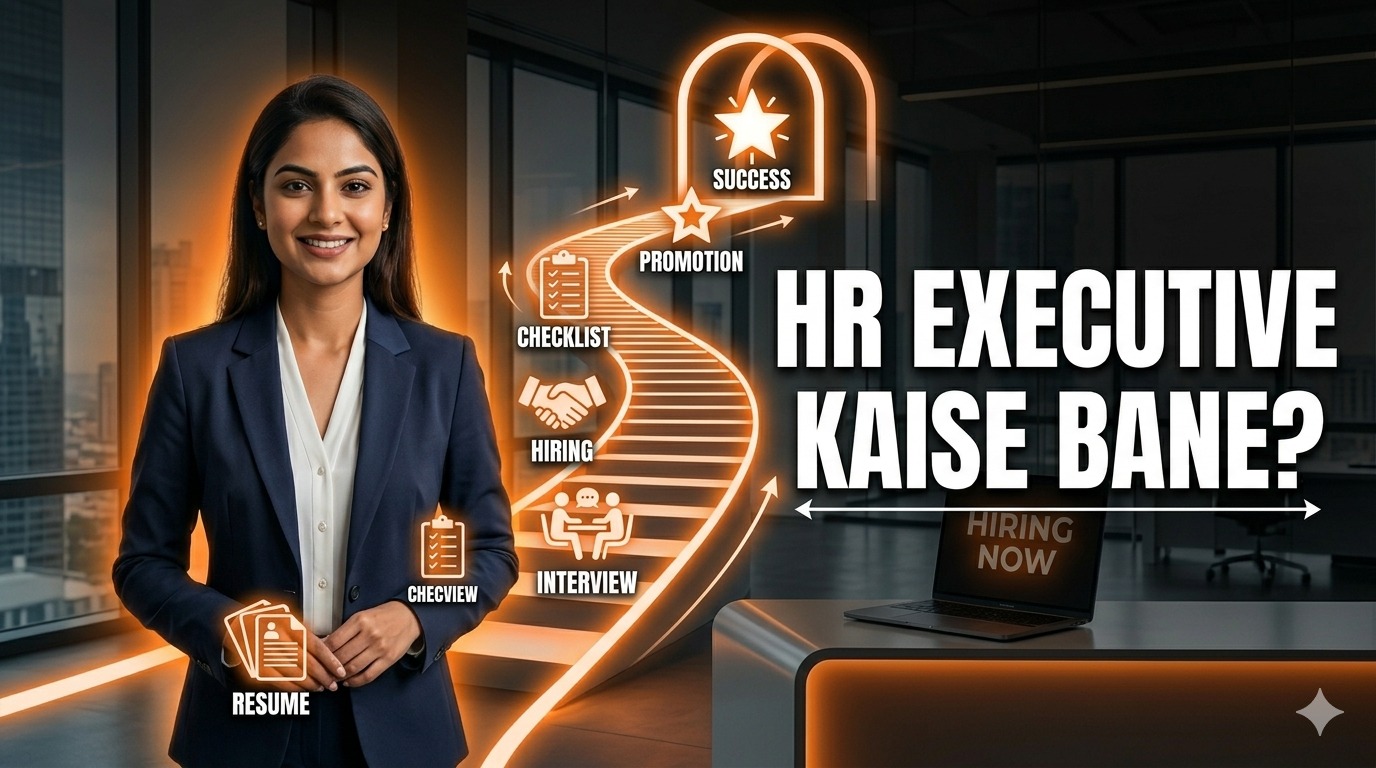
Whenever you walk into any company, a hospital, a tech startup, a retail chain, a manufacturing unit and somewhere in that building there is a person who knows every employee's name, handles their concerns, manages hiring when a new role opens up and makes sure the workplace runs smoothly from a people perspective.
That person is usually the HR Executive.
It is one of the important roles that exists in every industry, in every city, in companies of every size. Which makes it one of the most consistently available career options in India right now. And the path to getting there is more accessible and easy.
You do not need a specialised technical background. You do not need years of corporate experience to start. What you do need is a genuine interest in working with people, some foundational skills and a clear plan to build your career step by step.
This guide will teach you exactly that, a practical, honest roadmap to becoming an HR Executive in India, with real salary expectations for Jaipur, tips for both freshers and experienced candidates and the kind of advice that actually helps you move forward.
HR Executive Ka Role Kya Hota Hai?
Before figuring out how to become an HR Executive it helps to deeply understand what the job actually involves on a day-to-day basis.
An HR Executive is an important operational engine of the HR department. While an HR Manager sets strategy and makes big decisions, the HR Executive is the one on the ground, making sure everything runs smoothly.
Here is what a typical day might look like. In the morning you check pending interview schedules for instance three candidates are coming in today for a content writer role. You confirm their timing, send reminder messages and brief the hiring manager. Mid-morning a new employee who joined last week comes to you with a question about their salary structure. You explain it clearly and note their query for the payroll team. In the afternoon you update the attendance sheet, respond to two job applications that came in overnight and help prepare the monthly headcount report that the management has asked for.
There is a real example that brings this to life. An e-commerce company based in Jaipur's Sitapura area was scaling up fast and they needed to hire 15 warehouse coordinators and 5 customer support executives within six weeks. Their HR Executive managed the entire process: posted job ads, screened over 200 resumes, coordinated more than 60 interviews, handled offer letters and completed the joining formalities for all 20 final candidates - all while handling the daily HR operations of the existing 80-person team.
That is the scale and variety of what HR Executives actually deal with in their day to day operations. It keeps the job interesting and it builds your skills very quickly.
Skills Required for HR Executive Role
Let us break this down honestly - what you genuinely need versus what sounds good on paper.
- Communication is everything. This is not typical - it is the literal foundation of the HR Executive role. You are talking to job candidates, existing employees, department managers, and sometimes vendors every single day. Clear, warm, professional communication is what makes people trust you. And in HR trust is everything. Start working on your communication actively - not just English but the ability to express yourself clearly and listen carefully.
- Interviewing skills matter more than most freshers expect. Screening a resume is one thing, but conducting a structured interview that actually helps you judge whether a candidate is the right fit - that takes practice. Learn what kinds of questions reveal a candidate's actual capabilities versus just their rehearsed answers. Situational and behavioural questions are far more useful than generic ones.
- MS Excel and basic computer skills are non-negotiable. HR Executives maintain employee databases, track attendance, calculate leaves and prepare reports. You do not need to be an Excel expert from day one but you should be comfortable with basic formulas, filters and data management. YouTube has excellent free Excel tutorials - a few hours of practice per week for a month will get you there.
- HR software familiarity becomes important as you grow. Tools like Keka, Zoho People, Darwinbox and GreytHR are used extensively across Indian companies for everything from payroll to performance management. Familiarity with at least one of these makes you significantly more hire-able, especially for mid-level roles.
- Problem-solving and calm under pressure round out the skill set. HR Executives regularly deal with unexpected situations - a candidate drops out the day before joining, an employee raises a sensitive grievance, a system error messes up the attendance data. The ability to stay calm, think clearly and find solutions without escalating every small problem is what distinguishes a good HR Executive from an average one.
Qualification Required
- The standard minimum qualification for an HR Executive role is a graduation degree. BBA and MBA with an HR specialisation are looked upon favourably particularly for companies that prioritise structured HR practices.
- That said, a general graduation - BA, BCom, BSc - combined with an HR certification course is a perfectly valid path. Certifications from platforms like SHRM, Coursera, or even shorter courses from LinkedIn Learning or NIIT show employers that you have taken the initiative to learn HR seriously beyond your degree.
- Internship experience, even a brief one, changes your profile or portfolio significantly. Most companies hiring for entry-level HR Executive roles prefer candidates who have at least knowledge and some experience about real HR work - sat in on an interview, helped with documentation, maintained an employee tracker - over someone who has only studied HR theory.
- MBA in HR does accelerate growth especially toward managerial roles. But it is not a requirement to start. Many successful HR Managers in India began as executives with a basic graduation degree and worked their way up through consistent performance and skill development.
HR Executive Salary in India and Jaipur
Here is an honest picture of what you can expect to earn.
Pan India:
- Freshers (0 to 1 year): 12,000 to 25,000 per month
- Mid-level (1 to 3 years): 30,000 to 55,000 per month
- Experienced HR Executive (3 plus years): up to 70,000 per month
In Jaipur specifically:
- Freshers: 10,000 to 18,000 per month
- Mid-level with two to three years experience: 22,000 to 40,000 per month
- Senior HR Executive or HR Manager level: 42,000 to 65,000 per month
Jaipur may not match the salaries of Bangalore or Mumbai but the gap is narrower than most people think when you factor in cost of living. Rent, food, transport and daily expenses in Jaipur are significantly lower than metros. A 22,000 per month HR job in Jaipur leaves you with considerably more disposable income than a 32,000 per month role in Bangalore would.
The demand for HR Executives in Jaipur is real and growing. Industries hiring include IT and software services in Malviya Nagar and Vaishali Nagar, hospitality and tourism companies, educational institutes, healthcare facilities, real estate developers and manufacturing units in Sitapura and Bindayaka Industrial Area. If you are actively and genuinely applying and have even basic HR skills Jaipur gives you a genuine number of opportunities to choose from.
HR Executive Kese Bane - Step-by-Step
Here is the most practical roadmap available built around what actually works.
Step 1 - Complete your graduation. If you are still studying, focus on finishing your degree. BBA or any graduation with HR coursework is helpful but not mandatory. Use your college years to work on communication, participate in activities that involve people management like seminars and speech, and start reading about HR basics.
Step 2 - Develop core skills actively. Do not wait for a job to start learning HR. Take a free online HR course. Practice Excel daily for 20 minutes. It is the most important skill that everyone practices, especially in the HR field. Watch YouTube videos on how to conduct structured interviews. Read case studies about employee relations and how companies handle them. By the time you sit in your first interview these things should feel familiar.
Step 3 - Do an internship. This step cannot be emphasised enough. An HR internship - even unpaid, even at a small company - gives you the one thing that freshers almost universally lack: real experience. After even six weeks of working in an HR department your resume looks fundamentally different. You have actually screened resumes, coordinated interviews and maintained employee records. That matters enormously to hiring managers.
Step 4 - Build a strong, HR-focused resume. Your resume should be clean, professional, and focused on what actually matters for HR roles - communication abilities, any people management or coordination experience, software knowledge and your internship. Do not pad it with irrelevant information. One page for freshers is ideal. Get it reviewed by someone in the field if possible.
Step 5 - Apply consistently and strategically. Use job portals every day. Search specifically for HR Executive, HR Recruiter, HR Intern and Talent Acquisition Executive roles on online job portals. When applying, take 60 seconds to personalise your cover message for each company - mention something specific about their industry or role. It takes very little extra time and noticeably improves your response rate.
Step 6 - Prepare for HR interviews thoroughly. HR interviews are conversations not tests. They typically assess your communication, your understanding of basic HR concepts and your ability to handle real situations. Practice answers to questions like - tell me how you would handle a situation where two employees are in conflict, what would you do if a candidate rejected an offer at the last minute, how do you prioritise when you have multiple urgent tasks. Specific thoughtful answers always outperform vague ones.
Tips for Freshers
- Build your LinkedIn profile seriously and professionally. In HR especially hiring managers check LinkedIn regularly. A professional photo, a clear headline, your education, any internship experience and a few skills listed can lead to recruiter outreach even before you actively apply anywhere.
- Work on your communication every single day. Read professional content, write emails even in practice, watch interviews of HR professionals on YouTube. Communication does not improve overnight but it compounds steadily with consistent effort.
- Keep your HR basics sharp. Know the difference between gross salary and net salary, understand what PF and ESIC mean, know the basic stages of recruitment and placement. These come up in entry-level interviews regularly and simple clear answers show that you have done your homework.
- Do not skip internships because the pay is low. The learning curve during an internship is steep and the experience gained is worth far more than the stipend. Two months of real HR work will open more doors for you than six months of just applying without any practical background.
Tips for Experienced Candidates
- If you already have one to two years of HR experience, focus on deepening your expertise rather than staying generalist.
- Learn at least one HRMS tool properly - Keka, Zoho People or Darwinbox are widely used in India and proficiency in any of them is a genuine differentiator when applying for mid-level roles.
- Work on your recruitment strategy knowledge. Understanding talent mapping, employer branding and how to reduce hiring costs are topics that matter at the senior level. Bring data into your resume - "reduced average time-to-hire from 22 days to 14 days" says far more than "managed recruitment process."
- Develop your understanding of labour laws and compliance - PF regulations, gratuity rules, the POSH Act. Companies value HR professionals who understand the legal framework around employment because non-compliance creates serious business risk.
- Start thinking about leadership. If you want to move toward an HR Manager role, begin mentoring junior team members, lead recruitment drives and document your contributions in terms of impact. These become the stories you tell in senior-level interviews.
Common Mistakes to Avoid
- Ignoring communication development is the biggest career limiter in HR. You can know every HR tool and policy perfectly but if you cannot engage and communicate with people with warmth and clarity you will always be limited in how far you can grow.
- Skipping the internship as a fresher costs more than people realise. Companies hiring entry-level HR Executives almost always prefer candidates with some real-world HR exposure over those with only academic credentials.
- Weak resumes are a silent application killer. Generic objective statements, spelling errors, no mention of actual HR tasks or tools - these things send applications straight to the reject pile. Invest proper time in building your resume once and maintaining it well.
- Not preparing for interviews specifically is a mistake that shows up immediately. Saying "I am a people person" without being able to back it up with a specific example from your experience is a red flag in an HR interview. Prepare real stories, real situations, real outcomes.
Final Thoughts
Becoming an HR Executive is a goal that is genuinely within reach for most motivated graduates in India. The field rewards communication, empathy and consistency more than any specific technical skill - and those are qualities you can develop deliberately.
In Jaipur and across India companies are growing and they need HR professionals to help them manage that growth. The opportunity is real, the demand is consistent, the career path has plenty of room to grow - from Executive to Manager to HR Head over time.
Start building your skills today. Get that internship. Build your resume around what you have actually done. Apply every day with purpose.
Your first HR Executive role is a few consistent steps away.
Looking for HR Executive jobs across India? Check out Jobipo for the latest openings - no charges, direct hiring, and fast selection.


Comments