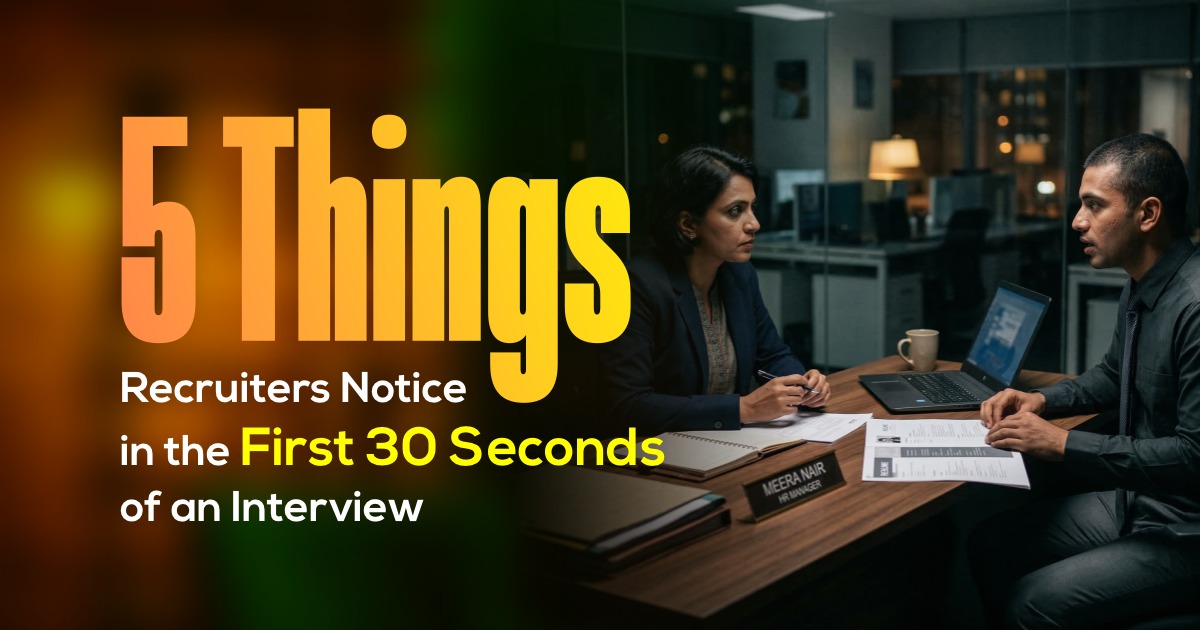
An interview is a two-way interaction process in which one person asks questions to get relevant answers from another. The interviewer not only conducts your interview but also checks your ability and identifies you. Your chances of getting hired will be determined by the first 30 seconds of the interview, regardless of how you answer any subsequent questions. Recruiters are highly trained observers, and will create a strong first impression about you through their observation within less than 30 seconds. Many times these first impressions will be derived from the recruiter's initial observations of your appearance, voice tone and body language and will be very strong. In this article, you'll learn the 5 primary aspects of a candidate that recruiters observe very quickly upon their arrival at an interview. By understanding these aspects, you can arrive at the job site ready, self-confident, and prepared to make a positive impact.
What Recruiters Notice in 30 Seconds?
5 silent things that recruiters notice in an interview with a candidate. If you know about these things, you can crack your interview.
1. Body Language & Posture
When you enter the interview, firstly, the interviewer notices one thing: your body language. walk straight, with a confident posture and not nervously fidgeting. It indicates a lot of things without saying a word. If you show yourself tired or uneasy, it gives a signal of weakness, whereas an upright posture shows confidence and professionalism.
Tip: Enter with your shoulders back, head high, and a natural stride.
2. Handshake & Eye Contact
If you are doing a handshake that is neither too tight nor too loose and make direct eye contact with the recruiter, this posture tells him about you instantly that you are self-assured. A weak handshake and talking without a handshake show a sign of your insecurity and disinterest. It seems like a small thing, but recruiters take it seriously.
Tip: Practice a firm handshake and hold eye contact for 3–4 seconds naturally.
3. Appearance & Grooming
"First impression is the last impression"- it's not only true, but it is also true. Your uniform, hair, nails and overall cleanliness tell the recruiter how serious you take seriious this job. A casual and untidy look shows that you have not done any preparation for the interview.
Tip: Always dress one level above the company's dress code. When in doubt, overdress.
4. Your Opening Words & Tone
"Hello, good morning!" - these simple words are also noticed by recruiters.
your voice tone, how clearly you talk or speak, or how confidently you greet? This all judges in 30 seconds. In nervousness, speaking loudly or slowly mumbling also puts a negative impression.
Tip: Speak clearly, greet warmly, and let your energy be positive from the very first word.
5. Punctuality & Entry Energy
Recruiter notes that you come on time or not, and when you come, check how to come - “And when you arrive, how will you arrive — breathless from running, or calm and prepared? If you arrive late, it is obviously not good, but early arrival and showing nervousness also impact your impression. Arriving 10 minutes before seems idle, and being composed.
Tip: Arrive 10 minutes early, take a breath, and enter the room calm and collected.
How to Introduce Yourself in an Interview — Perfect Script
Good morning, sir/ma'am. My name is [your name], I am from [your city], and I completed my degree [degree name] from [your university/college name].
During studies, I focused on [key subjects and projects]. I have [x years] of experience in this field. In my previous role at [previous company name], I worked on [key responsibilities] and achieved [notable achievements].
If you are a fresher, mention your projects and internship experience. I am particularly interested in this field [your reason]. I believe my skills in [Skill 1] and [Skill 2] will help me contribute effectively to your team. I am a quick learner, a team player, and I am highly motivated to grow in this field. I am very excited about this opportunity, and I look forward to contributing to [Company Name].
How to Stay Calm and Confident in a Stressful Interview
When hearing the name of an interview, you get nervous; it is not done only with you; it happens with 73% people who feel anxiety. But you know? Interviewer analyses differences between nervous and confident candidates in just 30 seconds at the start of the interview. Here are some key points that help you be calm and confident in stressful interviews.
Complete Calm & Confidence Checklist
1 Week Before
- Company research complete karo
- Top 50 interview questions prepare karo
- Mock interview practice karo
- Outfit decide karo
1 Day Before
- Documents ready rakho
- Route/location check karo
- Early so jaao
- Light dinner khaao
Interview Day
- 7-8 breathing karo
- Power pose karo
- 10 minutes early pahuncho
- Phone silent karo
- Smile karo aur confident enter karo
Conclusion
Vital to getting hired, an interview is not simply about answering questions correctly but rather about bringing forth the best version of oneself as well! Everything counts upon entering the interview appointment; meaning your posture, smile, handshake, spoken words, and energy all play an important part as to whether or not you receive an offer of employment after your interview. Employers do not want you to demonstrate that you are perfect in every sense; employers want candidates who demonstrate they are prepared, authentic, confident, and capable of meeting new challenges.






Comments