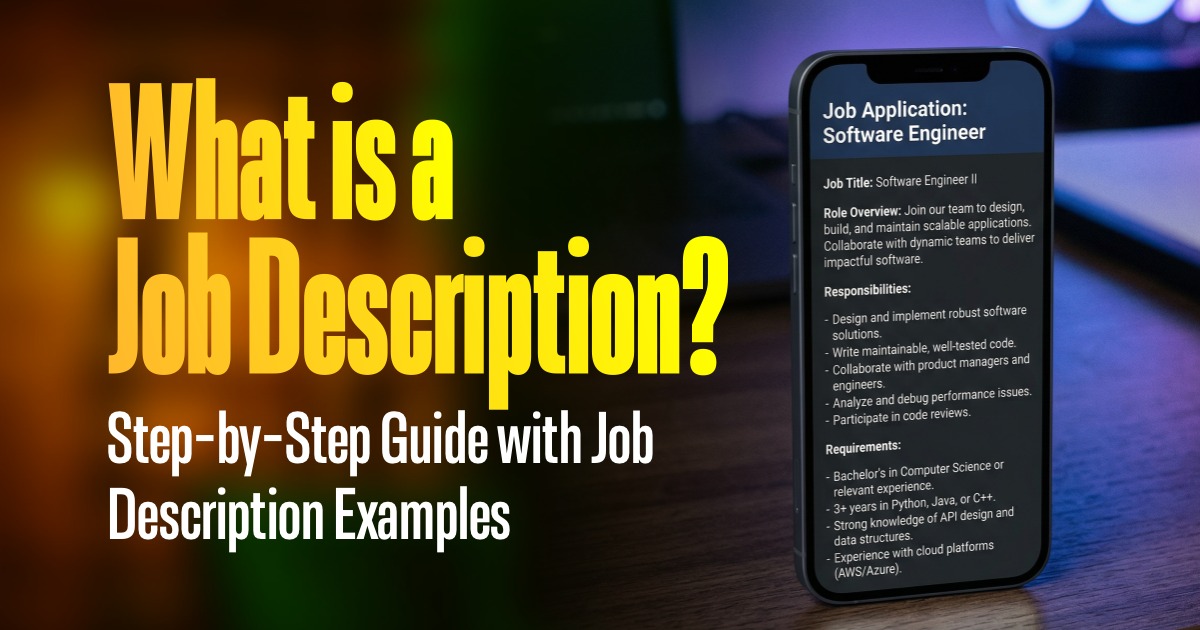
In today's competitive job market, a clearly written job description (JD) is not only a formality — it is a powerful hiring tool. Whether you are an HR professional, a startup founder, or a job seeker who wants to understand what expectations are met for any job, understanding a job description is an important thing.
A job description is an official document which clearly defines a specific role, like responsibilities, required skills, and expectations — both for the employer and the candidate.
in Simple words, JD is a bridge which connects the right candidate and the right job. If this bridge is weak, wrong candidates are applying, time is wasted, and the hiring process is slow.
In this article, we talk about the importance of job descriptions, components of job descriptions, a step-by-step guide on how to write a job description and some examples.
Why is the Job Description Important?
Most organisations copy-paste a generic JD and think their work is done. But it comes in the biggest hiring mistakes. a strong job description:
- attract qualified candidates and filter unqualified ones.
- Communicating the company's culture and values
- gives legal protection — it is the basis of clear job duties and performance reviews.
- help to understand the new employee's expectations (as onboarding)
- It is used in Internal promotions and salary benchmarking
Components of Job Description.
In a complete and effective JD, these sections are a must:
Core Sections
1. Job Title — Clear, specific, and searchable (e.g., "Digital Marketing Manager", not just "Manager")
2. Job Summary / Overview — 3–5 lines mein role ka brief description
3. Key Responsibilities — Bullet points in daily/weekly tasks
4. Required Qualifications — Education, certifications, experience
5. Preferred Qualifications — Nice-to-have skills (not mandatory)
6. Skills & Competencies — Technical + soft skills
7. Salary & Benefits — Compensation details (transparency builds trust)
8. Work Location & Type — Remote, hybrid, or on-site?
9. About the Company — Culture, mission, size
Step-by-Step Guide: How to Write a Perfect Job Description?
By following this step-by-step guide, you can improve JD. And able to write a strong and perfect job description.
1. Choose the right job title
The job title is the most searchable part of the JD. "Ninja", "Rockstar" ignore like that title avoid vague Use industry-standard titles which candidates actually search — like "Content Writer", "React Developer", "Operations Executive".
2. Write a compelling job summary.
This section grabs the attention of the candidate. Briefly explain: what is the role, how does it fit in the team, and what is the overall mission of the company? Keep it under 5 lines.
3. List Responsibilities Clearly
starts with Action verbs — "Manage", "Develop", "Coordinate", "Analyse". Avoid vague language: "Handle various tasks". Take a maximum of 8–10 bullet points.
4. Qualify Must-Have vs. Nice-to-Have
separate Required and preferred qualifications. Research shows that women often apply only when they meet 100% of the requirements, while men apply at 60%. Clear separation helps attract diverse talent.
5. Use Inclusive Language
Use gender-neutral language. In place of "He/She", use "They" or use the direct role name. Avoid coded words like "aggressive", "dominant" — this discourages certain candidates.
6. Mention Salary Range
Transparency builds trust. Mentioning the salary range not only attracts the right candidates but also saves time during negotiation. Especially, Gen Z candidates prefer salary-transparent jobs.
7. Highlight Company Culture
Work culture, growth opportunities, team environment — mention all those things that make a candidate genuine, that's how the company environment.
8. Proofread & SEO Optimise
Check grammar after the JD is published. Job portals (Naukri, LinkedIn, Indeed) search-based —include relevant keywords naturally, y which the JD search gives results.
Job Description Examples
Here are some examples which help HR improve job descriptions and not use a generic JD.
Example 1 — Content Writer (Entry Level)
Job Summary: We are looking for a creative Content Writer who can engage with blog posts, social media content, and write website copy.
Responsibilities: write SEO-friendly blogs | draft Social media captions | follow Content calendar |revisions of Editor's feedback
Requirements: Graduate in any stream | Strong Hindi/English writing skills | Basic SEO knowledge preferred
Salary: ₹15,000 – ₹25,000/month | Work from home available
Example 2 — Software Developer (Mid Level)
Job Summary: We're looking for a passionate React Developer to join our growing product team and help build scalable web applications.
Responsibilities: Develop and maintain React-based frontend | Collaborate with backend team on API integration | Participate in code reviews | Write clean, reusable code
Requirements: 2+ years React.js experience | Knowledge of REST APIs | Familiarity with Git | Node.js experience preferred
Salary: ₹8–14 LPA | Hybrid role | Noida/Gurugram
Avoid Common Mistakes
Keep an eye on this mistake, and also keep in mind what helps to avoid mistakes.
- Write Too long JD — candidates are skipping
- Vague responsibilities — "Perform other duties as assigned" is useless
- Unrealistic requirements — "5 years of experience in a 3-year-old technology"
- No mention of growth or learning opportunities
- Use the outdated JD without reviewing it.
Conclusion
A well-written job description is not only a hiring document — this is your company's first impression. Like a candid resume is an introduction of a candidate, a JD is an introduction of a company.
If you are in HR, treat your JD as your marketing piece. And if you are a job seeker, read the JD carefully, note keywords, and tailor your resume accordingly.
a clear, honest, and detailed job description — it is the root of successful hiring.






Comments